Story from the Skies
This blog post traces my personal journey of learning to fly a drone for cinematic filmmaking, from realizing that great footage takes more than expensive gear, to mastering the basics of flying, and then moving into composition, lighting, and emotion-driven shots. I break down eight essential cinematic drone movements I picked up along the way, and talk about how planning and learning from mistakes shaped my footage over time. One of the most memorable moments was an unplanned encounter with an eagle circling my drone near IIT Guwahati, which turned into one of the best shots I've captured, despite coming from panic rather than planning.
4 min

My Journey into Aerial Cinematography
When people watch a beautiful aerial shot in a film, they usually assume it just takes an expensive drone. It doesn't. I found that out the hard way.
I was drawn to aerial cinematography long before I owned a drone , watching how a single aerial shot could shift the entire feel of a scene. So when I finally got my hands on one, I assumed cinematic footage would come quickly. It didn't. My first flights were shaky, my camera angles were rarely in symmetry, my altitude control was inconsistent, and coordinating direction with the camera felt like trying to coordinate two completely unrelated movements.
How I Learned to Fly:
Before exploring cinematic techniques, you must first master the fundamentals:
Practice in an open space — a park or field, away from trees and people, so mistakes are cheap.
Learn each control in isolation — throttle, rotation, forward/back, side to side — before combining them.
Master hovering. Holding one spot at one altitude is the foundation for every shot that follows.
Drill takeoff and landing until they're boring — most beginner accidents happen in those first and last few seconds.
Know your flight modes, battery limits, and range, and what happens if you lose signal.
Repeat the same simple flight path until it takes no conscious effort. That's what turns movement into muscle memory.
Transitioning from Pilot to Filmmaker
Flying is only the technical skill — the rest is filmmaking. I studied composition, leading lines, light at sunrise and sunset, and pacing. Before every shot now, I ask one question: what emotion is this supposed to create? That question changed everything.
I also learned that slow movement almost always beats fast. Push-ins, orbits, slow reveals, tracking shots — smoothness reads as intentional; speed reads as amateur.
Essential Cinematic Drone Shots I've Mastered
Grasping the fundamentals is key, but mastering shot terminology significantly improves on-set efficiency and communication:
The Dronie — the drone flies backward and upward at the same time, pulling away to reveal the landscape.
The Orbit (360 Wraparound) — the drone circles a fixed subject while the camera stays locked on it.
Top-Down (Bird's Eye) — the camera points straight down, flying over patterns, roads, or rivers.
Push-In / Pull-Out — the drone moves straight toward or away from a subject.
Pedestal (Boom Up/Down) — the drone rises or descends vertically without moving horizontally.
Tracking / Chase Shot — the drone follows alongside or behind a moving subject.
Parallax Shot — the drone slides sideways while rotating the opposite way, creating depth.
Reveal Shot — the drone moves from behind an obstacle or descends to expose a hidden subject.
Planning Matters More Than Instinct
Great drone shots are rarely spontaneous. Before every shoot, I plan the location, flight path, time of day, lighting, weather, and battery management in advance — so once I'm in the air, I'm focused on creativity, not troubleshooting.
Every Mistake Was Feedback
Overexposed shots, shaky footage, wind I underestimated — none of it felt good in the moment, but each one taught me something specific to fix. That shift in mindset improved my flying more than any tutorial did.
The Eagle Encounter
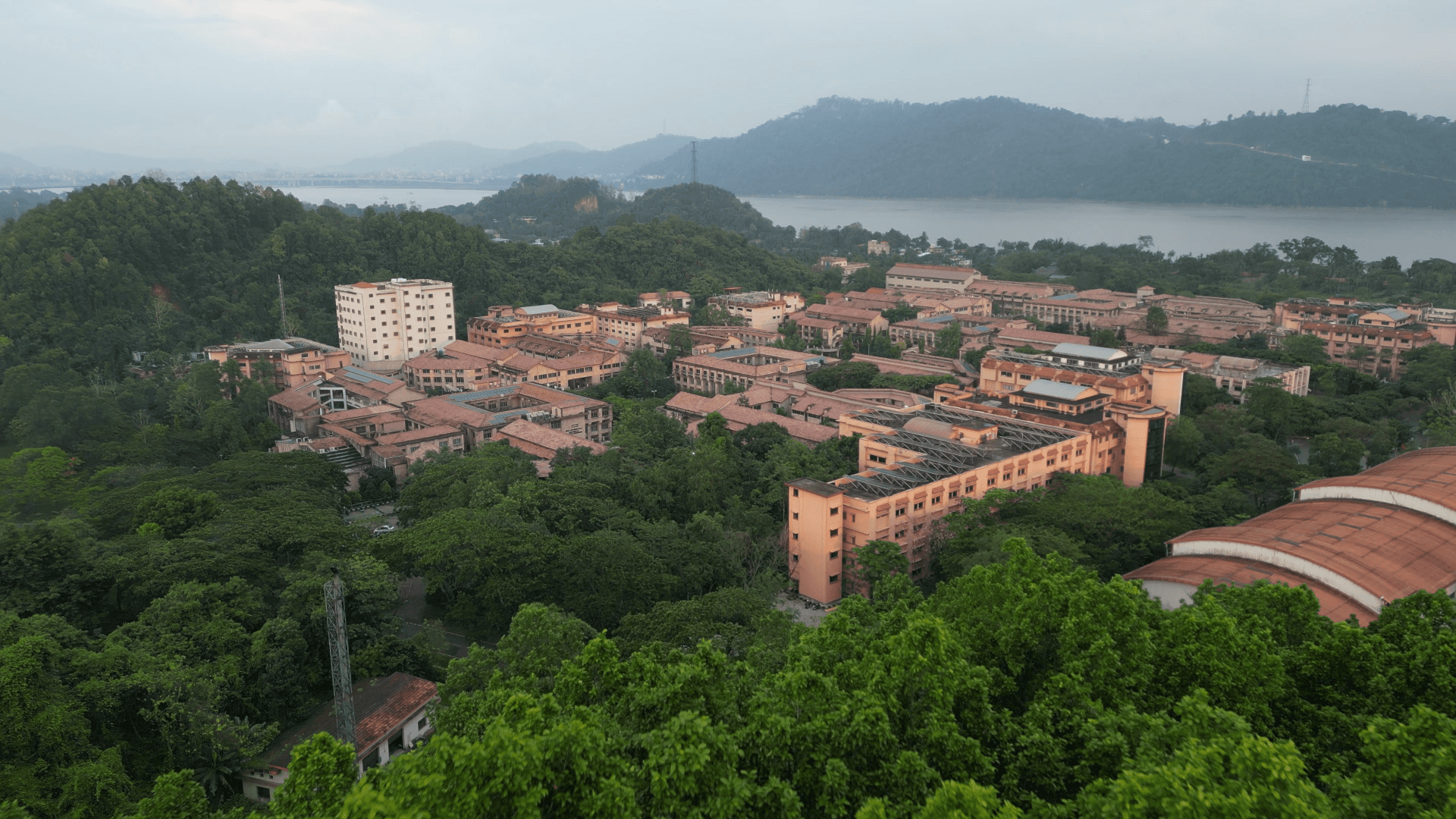
One of the most memorable moments of this journey happened while flying near IIT Guwahati campus, close to the IITG Hospital. Mid-flight, an eagle suddenly appeared and started circling the drone. I panicked, worried it might attack, and quickly switched to sport mode, pulled the drone back, and landed.
It was only while reviewing the footage that I realized how lucky I'd gotten — the camera had captured the eagle gliding in from the front and soaring right above the drone. What felt like a stressful, split-second decision turned into one of the most striking shots I've ever gotten, completely unplanned.
Not every great shot comes from planning. Sometimes it comes from staying calm and having the camera rolling when it matters most.
The Real Lesson
A drone should never be used just because it looks impressive. Every aerial shot needs a reason — revealing a place, following a character, showing scale. Otherwise it's just a novelty.
At Vision & Co, we believe technology and creativity should move together. My journey with drones is still evolving, but if there's one thing I've learned, it's this: great drone cinematography doesn't begin when the drone takes off. It begins with curiosity, planning, and the willingness to keep learning.
Join the newsletter
Be the first to read our articles.


