When the forests blink back: Explore wildlife through camera traps
Camera traps silently capture the hidden lives of wildlife, helping researchers study animal behaviour, distribution, and conservation without disturbing nature. By combining careful field placement with modern AI tools, they transform thousands of images into valuable ecological insights. More than just cameras, they are powerful instruments for protecting biodiversity and understanding the forests that come alive after dark.
10 min

At midnight, when the forest seems silent, an entirely different shift begins. Civets slip between tree roots, deer approach waterholes, porcupines investigate fallen fruit and predators quietly patrol familiar trails. Most of this activity occurs beyond human sight—but not beyond the gaze of a camera trap. Camera trap is a device that acquires data on sensing a physical phenomenon, for example, taking a picture on sensing motion, or vibration. They are remotely operated cameras that document wildlife automatically, often for weeks or months. They help researchers study species' presence, behaviour, habitat use, activity patterns, and interactions among wildlife, livestock, and people without requiring someone to remain continuously in the field. They also create permanent photographic records that can be re-examined and verified later.
A camera waiting for its moment
A typical camera trap resembles a rugged outdoor box attached to a tree trunk or a big post. Inside it are a digital camera sensor, lens, memory card, batteries, and electronic controls. On the front are infrared lights and a passive infrared—or PIR—sensor protected by a patterned Fresnel lens. Contrary to a typical assumption, the PIR sensor does not simply “see movement”. It responds to shifts in infrared radiation across its detection zones. When a warm animal moves against a cooler background, the changing thermal signal activates the camera. Detection therefore depends on the species size, speed, direction, distance and temperature contrast with the environment.
Choosing your first camera trap
Camera traps come in several styles, each with its own wildlife superpower. No glow infrared models, such as the Browning Spec Ops Elite or REconyx HeperFire, work quietly in the dark and are perfect for shy animals such as tigers, leopards or slow lorises. Their night images are usually black and white.Low-glow cameras including Browning recon force series, produce a faint red light and can capture clearer footage of species, although a curious animal may stop and stare at the mysterious glow. White-flash cameras create color photographs at night, making them useful for learning coat patterns ,scars and markings on animals.The trade-off is that the sudden flash may surprise sensitive wildlife.
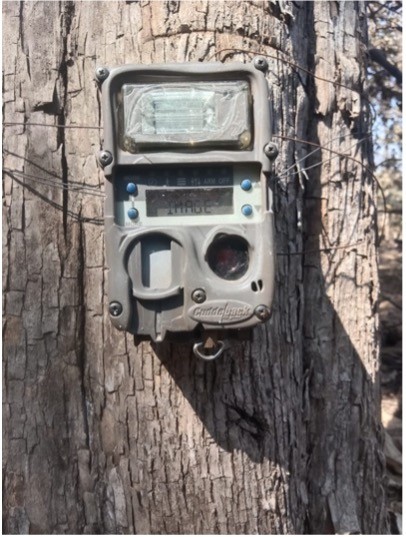
Figure 1 : Cuddeback X-Change Color Model 1279 camera trap mounted on a tree for remote wildlife monitoring.
Cellular cameras can send images directly to a phone or computer, which is handy for detecting elephants near villages or tigers using forest corridors. Video models capture behaviour such as scent marking, feeding and family interactions , while newer AI-enabled systems can identify animals, people or vehicles and send rapid alerts regarding illegal activities like poaching. For beginners, a simple no-glow or low-glow camera with good battery life, weather protection and reliable night vision is often the smartest choice. The best camera is not the fanciest one , it is the one that matches the animal, habitat and purpose of the study.
Megapixels are not everything
A box advertising “48 megapixels” may sound impressive, but the number may refer to digitally enlarged or interpolated files rather than the camera’s true native sensor resolution. Enlarging a file does not create missing fur patterns, whiskers or stripes. Useful specifications include trigger speed, recovery time, detection range, flash range, field of view, burst mode, video resolution, memory capacity, battery life and weather resistance. A fast trigger counts when an animal dashes across a narrow trail; fast recovery helps record several animals foraging together. Image quality also relies on lens performance, sensor size, focus, lighting, compression, camera angle, distance and the speed of the animal. Daylight photographs are generally in colour, infrared night photographs are monochrome, and white-flash cameras can produce colour images at night. Anticipate occasional photographic comedy like a glowing moth filling the frame, a leaf generating 400 empty photographs, a blurry tail disappearing from view or a curious elephant inspecting the camera too closely. Rain, condensation, moving vegetation, insects, infrared reflection and animals departing outside the ideal focus zone can all reduce image quality.
Field placement: Think like an animal
Begin with a question. Are you documenting all mammals using a campus woodland, monitoring a leopard trail, tracking poachers and illegal activities, or comparing activity near roads and undisturbed forest? Look for tracks, droppings, scratch marks, scent-marking sites, water sources, narrow trails and natural crossings. Mount the camera securely and position it according to the target species. A unit monitoring rodents or ground birds should usually be lower than one intended for deer, elephants or large carnivores. Avoid facing the camera directly towards sunrise or sunset. Remove only vegetation likely to obstruct the lens or repeatedly activate the sensor. Before leaving, perform a walk test, check the batteries and memory card, confirm the date and time, and record the camera ID, coordinates, habitat and settings.
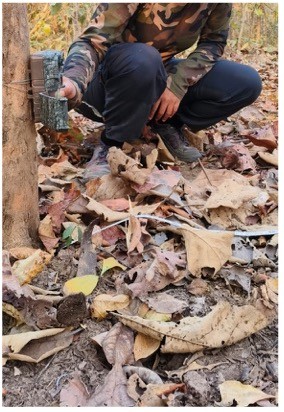
Figure 2 Final adjustment of camera height and sensor direction to maximise wildlife detection.
From species to individuals
Researchers identify species using body size, coat colour, ear and tail shape, horns, posture, gait, behaviour, habitat and activity time. Partial images, juveniles and similar-looking species can cause identification difficult, so doubtful records should be checked by experienced observers.

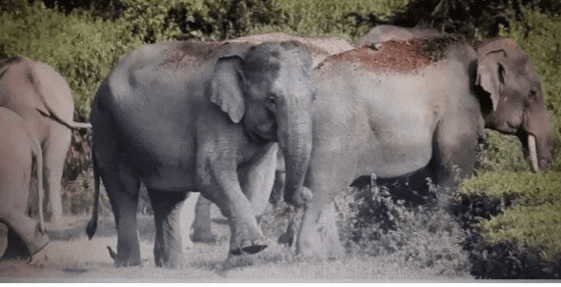
Figure 3 : The forest’s largest commuters: These camera trap images document a herd of Asian elephants (Elephas maximus) moving through an elephant corridor in Kaziranga National Park
Recognising an individual is a different challenge. Tiger stripes, leopard rosettes, zebra patterns and giraffe patches function almost like visual fingerprints. Elephants may be recognised from ear shape, tusks and scars, while some bears have distinctive chest markings. Camera-trap photographs of patterned carnivores can therefore support individual capture histories and population estimation. Paired cameras are often placed on opposite sides of a trail to photograph both flanks of tigers or leopards.
Forests meet AI
A successful survey can generate thousands of photographs and many may comprise nothing but waving grass. MegaDetector can separate images containing animals, people or vehicles from empty frames, but it does not independently specify animals to species. SpeciesNet and Wildlife Insights can suggest species classifications, while Wildbook and HotSpotter assist with individual matching. Timelapse, Camelot and Agouti support image organisation and annotation. QGIS, ArcGIS and R help researchers map detections and analyse ecological patterns. CyberTracker, SMART Mobile, QField and KoboToolbox are useful for field forms, locations and metadata. AI is fast, but it is not infallible. Infrared photographs, rare species, juveniles, dense vegetation and unfamiliar regions can confuse models. Every important classification should therefore receive human verification. Camera traps record an animal at one place and time; they do not continuously track its journey. Continuous movement monitoring normally requires GPS collars, satellite tags or radio telemetry.
More than beautiful photographs
Camera traps display nocturnal activity, feeding, courtship, territorial marking, parental care, predation, scavenging and responses to roads, tourism, livestock and settlements. However, twenty photographs do not necessarily mean twenty animals, the same individual may trigger a camera often. Responsible use is important. Obtain permission, follow protected-area regulations, avoid unnecessary baiting, protect endangered-species locations and securely manage photographs of people. Ethical guidance emphasises informed engagement with local communities and protection of the privacy of anyone unintentionally photographed. For beginners, the best camera trap is not necessarily the most expensive. It is the one deployed with a clear question, careful positioning, accurate field notes, ethical judgement—and enough patience to discover who walks through the forest after everyone else has gone home.
About the author
Jebin Ahmed is a PhD researcher at IIT Guwahati, exploring climate-smart agriculture and environmental sustainability. Before diving into crops and climate, she spent time tracking wildlife through camera traps, identifying species, and uncovering the secret lives of animals. She also enjoys science communication, photography, and turning research into engaging visual stories.
Join the newsletter
Be the first to read our articles.


